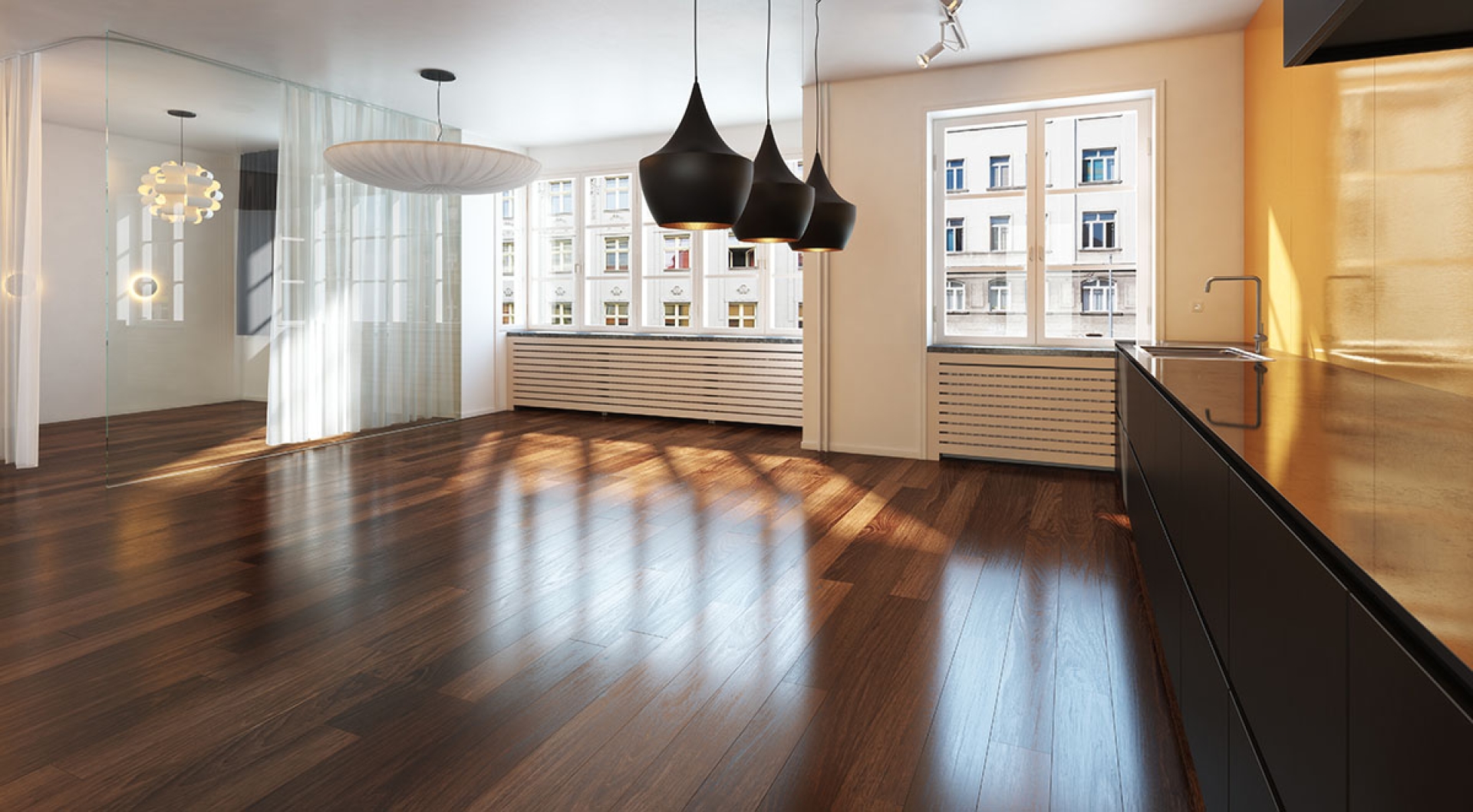
What Makes a Hardwood Good for Flooring?
The Janka hardness test measures the force required to press a steel ball into a piece of wood. Flooring manufacturers and buyers use the rating to compare the relative dent resistance of different species. The National Wood Flooring Association lists true hickory at approximately 1,820 pounds-force, white oak at 1,360, ash at 1,320, red oak at 1,290, walnut at 1,010, and black cherry at 950.
Those numbers provide useful context, but hardness alone does not determine whether a species belongs in a particular room. Flooring buyers should also consider:
- Dimensional stability: Wood expands and contracts as its moisture content changes. Some species and sawing methods move more than others.
- Grain pattern: Open, pronounced grain can help conceal small dents, scratches, and normal wear.
- Color variation: Some floors have relatively consistent coloring, while others contain sharp contrasts between heartwood and sapwood.
- Finish selection: The finish affects sheen, stain color, surface protection, and how visible everyday wear becomes.
- Traffic level: Entryways, kitchens, retail spaces, and busy living areas usually need greater dent resistance than bedrooms or formal rooms.
- Board width: Wider solid boards generally show seasonal movement more clearly than narrow flooring strips.
- Grade: Clear grades create a more uniform appearance, while character grades may include knots, mineral streaks, color changes, and other natural markings.
The National Wood Flooring Association also notes that no two boards are identical, even when they come from the same tree. Species data should be treated as a guide rather than a guarantee of how every board will behave.
Seven of the Best Hardwoods for Flooring
1. Rift and Quartered White Oak Flooring
Rift and quartered white oak is one of the best hardwoods for flooring when stability and consistent grain are major priorities. The boards are cut at controlled angles to the growth rings rather than being produced entirely through conventional plain sawing.
Rift-sawn white oak generally displays clean, straight grain with limited ray fleck. Quarter-sawn boards have relatively straight grain as well, but they may show the decorative medullary rays associated with quartered oak. Combining the cuts gives flooring manufacturers access to linear grain, visible figure, and improved width stability.
Quarter-sawn lumber is more dimensionally stable across its width than plain-sawn lumber because of the orientation of the growth rings. That can be particularly valuable for wider flooring, large rooms, long visual runs, and projects where board movement needs to be carefully controlled.
The tradeoff is cost. Producing rift and quartered lumber requires more log handling, specialized sawing, and sorting. The process also produces narrower boards and a lower yield from each log. Select Hardwoods carefully sorts its rift and quartered white oak according to grain, figure, dimensions, and other project requirements.
Rift and quartered white oak flooring works especially well for:
- Contemporary interiors that call for straight grain
- Arts and Crafts designs that feature ray fleck
- Wide-plank flooring
- Large residential installations
- Custom commercial and architectural projects
2. Plain Sawn White Oak Flooring
Plain sawn white oak provides the durability of white oak with a more traditional grain pattern and a generally lower material cost than rift and quartered stock.
The growth rings intersect the board face at a lower angle, creating the broad arches commonly called cathedral grain. This pattern gives the floor more visible movement and variation. It can also make ordinary dents and scratches less noticeable than they might be on an extremely uniform surface.
White oak averages approximately 1,360 pounds-force on the Janka scale, placing it above red oak, ash, walnut, and cherry in comparative dent resistance. The National Wood Flooring Association also identifies white oak as a recognized domestic flooring species with established grading categories.
Plain sawn white oak is hard, heavy, and highly resistant to wear. It can serve flooring manufacturers that need dependable material, efficient log yield, broader grain variation, and access to multiple dimensions and grades.
Plain sawn white oak is a good fit when the project needs:
- Visible cathedral grain
- Traditional hardwood character
- Reliable resistance to everyday wear
- Better material yield
- A balance between performance and price
3. Red Oak Flooring
Red oak has been used for hardwood flooring for generations. It is durable enough for regular residential traffic, readily accepts many stains, and has pronounced grain that helps give a floor visual texture.
The species averages approximately 1,290 pounds-force on the Janka scale. That places it slightly below white oak but still within a useful range for living rooms, bedrooms, dining rooms, hallways, and other common residential applications.
Red oak generally has a warmer appearance than white oak, with colors that can range from light tan to pinkish and reddish brown. Its open grain responds well to stains, allowing manufacturers and finishers to create colors ranging from natural and honey-toned to medium brown or dark espresso.
Red oak may be the right flooring hardwood for projects that prioritize:
- Familiar oak grain
- Warm natural coloring
- Broad stain options
- Established flooring grades
- Material availability and value
4. Hickory Flooring
Hickory is the hardest domestic flooring option on this list. True hickory averages approximately 1,820 pounds-force on the Janka scale, substantially higher than either red or white oak. It also has excellent shock resistance, which helps explain its long history in tool handles and other products exposed to repeated impact.
That hardness makes hickory useful for active households, high-traffic rooms, rural properties, vacation homes, and spaces where dent resistance is a primary concern. However, hardness does not mean the material will never scratch or show wear. The finish, cleaning practices, furniture protection, and amount of grit tracked across the floor still matter.
Hickory flooring has pronounced color variation. Light cream sapwood may appear next to tan, reddish, or brown heartwood. This contrast gives hickory a bold appearance, especially in character grades. The grain can also be straight, irregular, or somewhat wavy.
5. Ash Flooring
Ash offers a useful combination of strength, hardness, and lighter coloring. With an average Janka rating of approximately 1,320 pounds-force, it falls between white oak and red oak.
Its grain is bold and generally straight, with an open, ring-porous structure similar in some respects to oak. The heartwood may range from light to medium gray-brown, while the sapwood is often beige or light brown.
Ash works well when a floor needs visible grain without the exact appearance of oak. Natural or lightly stained ash can brighten a room, while darker stains emphasize its open grain. It also has good strength relative to its weight and is listed by Select Hardwoods for flooring, furniture, doors, cabinetry, and architectural millwork.
Ash flooring is particularly useful for:
- Light-colored interiors
- Modern and transitional designs
- Projects that need pronounced grain
- Residential floors requiring good dent resistance
- Custom floors intended to differ from standard oak
6. Black Walnut Flooring
Black walnut is selected primarily for its color and character. Its heartwood can range from medium brown to deep chocolate, often with darker streaks and occasional purple, gray, or reddish tones. The grain is commonly straight but may also be curly, wavy, or irregular.
Walnut averages approximately 1,010 pounds-force on the Janka scale, making it softer than oak, ash, and hickory. That does not prevent it from being used for flooring, but it does affect where and how it should be specified.
Walnut is often best for bedrooms, home offices, formal living areas, private libraries, and other rooms where appearance matters more than maximum dent resistance. It can also be used as an accent, border, inlay, or contrasting section alongside a lighter species.
Its rich natural color reduces the need for dark stain. A clear or lightly toned finish can preserve the contrast between boards while allowing the wood’s natural figure to remain visible.
7. Black Cherry Flooring
Black cherry flooring offers warm color, fine grain, and a smoother visual texture than oak, ash, or hickory. Freshly milled cherry may appear pinkish or light reddish brown, but it darkens considerably with age and exposure to light.
Its average Janka rating is approximately 950 pounds-force, making it one of the softer hardwood flooring choices on this list.
Cherry is therefore better suited to lower-traffic residential rooms than busy entries, kitchens, or heavily used commercial spaces. It can work well in bedrooms, studies, dining rooms, and formal areas where its deepening color becomes part of the design.
Flooring manufacturers should account for its natural color variation and photosensitivity. Rugs, furniture, and areas receiving different amounts of sunlight may cause the floor to develop color unevenly at first. Over time, exposed areas generally deepen to the reddish-brown color associated with aged cherry.
How to Choose the Best Hardwood Flooring Species
There is no single species that works best for every floor. Hickory may provide the greatest dent resistance, but its color variation and movement are not right for every project. Walnut and cherry offer rich color, but they require more acceptance of dents and normal wear. Red and white oak remain dependable choices because they balance hardness, grain, availability, finishing options, and established flooring grades.
Before ordering material, consider the following questions:
- How much traffic will the finished floor receive?
- Are pets, children, or heavy furniture part of the environment?
- Should the grain be bold, straight, uniform, or highly varied?
- Is the desired floor light, medium, reddish, or dark?
- Will the lumber be used for narrow strips or wide planks?
- Does the project require plain sawn, rift-sawn, or quarter-sawn material?
- How much character is acceptable within the grade?
- What moisture content and machining specifications are required?
A clear specification helps the hardwood supplier identify the correct species, cut, grade, thickness, width, and quantity.
Choose Select Hardwoods for Hardwood Flooring Products
Select Hardwoods supplies Appalachian hardwood lumber for flooring manufacturers, distributors, builders, and specialty woodworking operations. Available species include rift and quartered white oak, plain sawn white oak, red oak, hickory, ash, walnut, cherry, soft maple, poplar, and sycamore. The company also offers specialty sorting, custom dimensions, surfacing, and other options based on project requirements.
Whether your flooring project calls for the stability of rift and quartered white oak, the familiar grain of red oak, the hardness of hickory, the lighter appearance of ash, or the rich coloring of walnut and cherry, Select Hardwoods can help you evaluate the available material.
Choose Select Hardwoods for hardwood products for flooring. Contact our team to discuss species, grades, dimensions, quantities, and lumber specifications for your next residential, commercial, or manufacturing project.