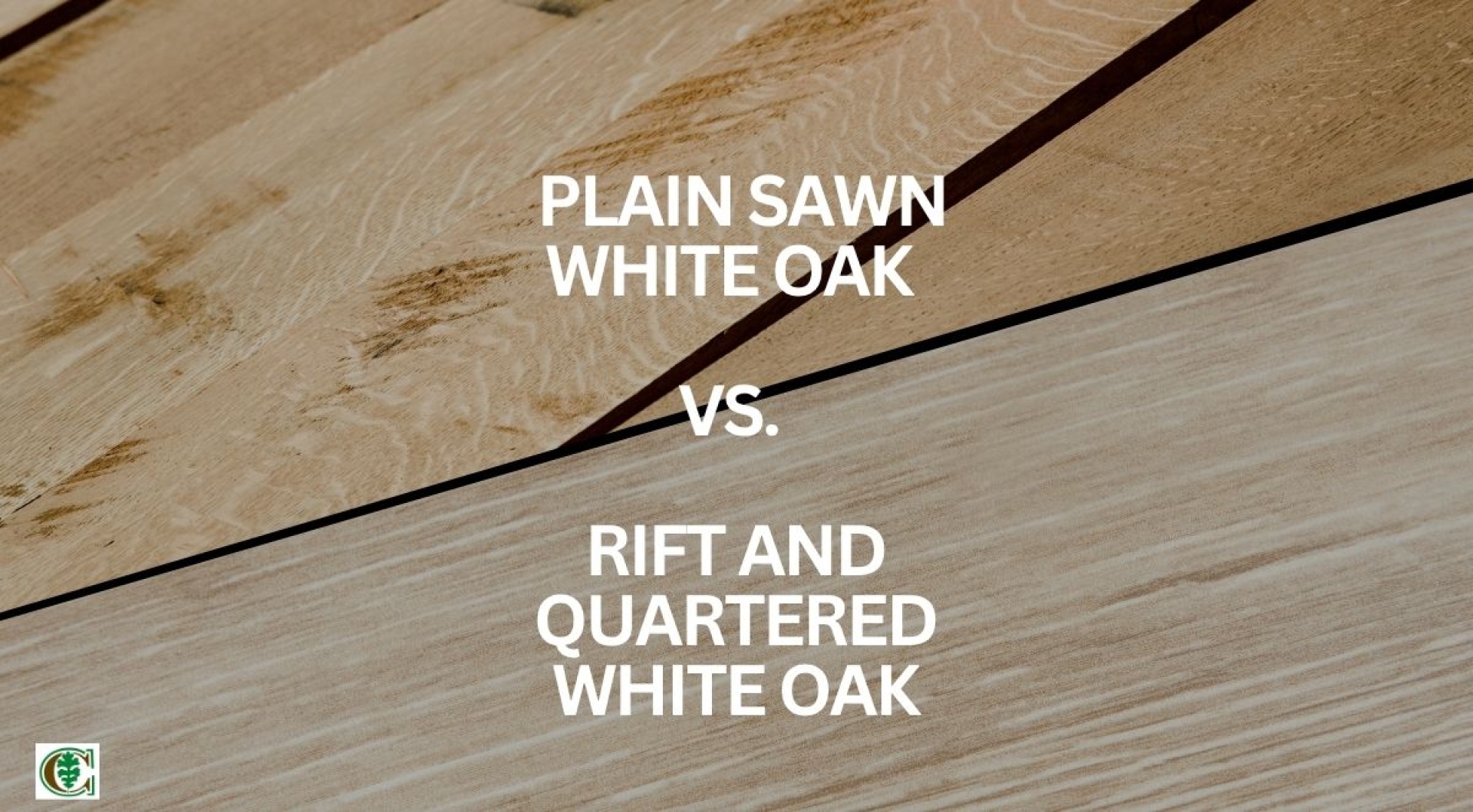
What Is Plain Sawn White Oak?
Plain sawing, also called flat sawing, is the most common method used to turn a log into lumber. The saw makes a series of relatively straight cuts through the log, producing a high volume of usable boards with limited log rotation.
The growth rings usually meet the face of a plain sawn board at a lower angle. This orientation creates the broad U-shaped or V-shaped patterns commonly called cathedral grain. Some parts of the board may show straighter grain, but the overall appearance tends to have more movement and variation than rift or quartered stock.
Select Hardwoods describes plain sawn white oak as a hard, heavy hardwood with strong wear resistance, light-colored sapwood, brown heartwood, and a medium-to-coarse texture. It is available in multiple grades, thicknesses, and width sorts for furniture, flooring, cabinetry, millwork, doors, moulding, paneling, and other applications.
Benefits of Using Plain Sawn White Oak
Plain sawing makes efficient use of the log. It can produce wider boards, requires a simpler milling pattern, and generally provides more lumber from each log than specialty sawing methods. Those advantages usually make plain sawn white oak more widely available and less expensive.
Its grain variation is also valuable in the right design. Cathedral patterns can add character to tabletops, cabinet doors, flooring, wall panels, and furniture. A clear finish can preserve the natural contrast within the grain, while stain can make the pattern more pronounced.
The main tradeoff is consistency. One board may have large arches across the face, while the next may show tighter or straighter grain. Large projects may require additional sorting when the finished components need to match closely.
What Is Rift and Quartered White Oak?
Rift and quartered white oak is produced by cutting boards at controlled angles to the growth rings. Rift sawing and quarter sawing are different methods, but lumber suppliers frequently group the resulting boards into a combined rift and quartered product.
Quarter-sawn white oak is cut more nearly perpendicular to the growth rings. This orientation exposes the wood rays and creates the flakes, ribbons, or shimmering figure associated with quartered oak. Rift-sawn white oak is cut at an intermediate angle, producing straighter, pencil-like grain with less visible ray fleck.
We supply rift and quartered white oak for projects that benefit from controlled grain, board-to-board consistency, and reduced movement across the width. Common applications include flooring, cabinetry, furniture, doors, paneling, and architectural millwork.
Rift-Sawn vs. Quarter-Sawn White Oak Grain
Rift-sawn boards are usually selected for clean, linear grain. This appearance works well for contemporary cabinets, long flooring runs, doors, and repeated components where the grain should remain visually consistent.
Quarter-sawn boards also have relatively straight grain, but the exposed medullary rays create a more decorative face. Quartered white oak is closely associated with furniture, Arts and Crafts interiors, and millwork that uses ray fleck as a deliberate feature.
Flat sawing exposes only the ends of oak’s rays, while quarter sawing cuts parallel to them and produces the characteristic flake pattern. Rift cutting intersects the rays at a different angle, creating a straighter, pencil-striped appearance.
Plain Sawn White Oak vs. Rift and Quartered White Oak
The main differences can be summarized this way:
- Grain pattern: Plain sawn white oak commonly shows cathedral grain. Rift-sawn boards show straighter lines, while quarter-sawn boards may feature pronounced ray fleck.
- Dimensional stability: Rift and quartered boards generally move less across their width as humidity changes.
- Log yield: Plain sawing recovers more lumber through a simpler cutting pattern.
- Price: Rift and quartered white oak normally costs more because it requires added handling, log rotation, sorting, and material.
- Matching: Rift and quartered boards are often easier to coordinate across cabinets, flooring, doors, and paneling.
- Visual character: Plain sawn lumber offers more natural variation. Rift and quartered lumber provides greater control over the finished appearance.
Dimensional Stability and Wood Movement
All solid wood expands and contracts as its moisture content changes. The amount of movement differs according to the direction of the growth rings.
Wood shrinks most in the tangential direction, along the growth rings, and roughly half as much in the radial direction, across the rings. Plain sawn boards place more tangential movement across the face. Quartered boards orient the more stable radial direction across the face.
This is why rift and quartered white oak generally has a lower tendency to cup and shows less width change than plain sawn material. The difference can be particularly important for wide boards, doors, flooring, panels, and other components where movement may become noticeable.
Best Uses for Plain Sawn White Oak
Plain sawn white oak is a practical fit when a project needs durable hardwood, broad availability, and prominent grain character. It is commonly used for:
- Furniture: Cathedral grain can become a central feature on tables, case goods, chairs, and custom pieces.
- Cabinetry: Door panels and drawer fronts gain visible variation, especially under clear or stained finishes.
- Flooring: Mixed grain patterns create the traditional appearance associated with many white oak floors.
- Moulding and millwork: Narrower components can use the strength and workability of white oak without requiring specialty grain.
- Paneling and doors: Plain sawn boards add warmth and natural movement to interior surfaces.
Plain sawn lumber is often the better value when parts are narrow or short, grain matching is not strict, or the design intentionally uses variation. Cathedral grain can be reserved for prominent components, while straighter sections can be used where a quieter appearance is preferred.
Best Uses for Rift and Quartered White Oak
Rift and quartered white oak becomes more valuable when straight grain, stability, and repeatable appearance are central to the project.
Flooring and Large Interior Surfaces
Long flooring runs make grain direction and seasonal movement easy to see. Rift and quartered flooring creates a more linear appearance and can reduce the width movement associated with flat grain.
Rift boards keep the floor visually restrained, while quartered boards introduce ray fleck. Manufacturers and designers can use a mixture of the two or specify a preferred balance based on the intended appearance.
The same benefits apply to wall paneling, ceilings, built-ins, and other large surfaces where multiple boards must work together visually.
Cabinets, Doors, and Architectural Millwork
Cabinet doors, wall panels, and architectural components need to remain aligned through humidity changes. Rift and quartered stock can help reduce cupping while creating a more uniform run of visible parts.
Straight rift grain works especially well when several doors, drawer fronts, stiles, panels, or trim pieces must look related. Quartered boards are useful when decorative ray figure is part of the design.
Rift and quartered material can also simplify board selection for long production runs. A manufacturer may spend less time trying to match dramatically different cathedral patterns across adjacent components.
How to Choose the Right White Oak Cut
Start with the finished product rather than the price per board foot alone.
Choose plain sawn white oak when cathedral grain fits the design, natural variation is acceptable, wider availability matters, and the parts can accommodate normal wood movement.
Choose rift and quartered white oak when the project requires straight grain, visible ray fleck, tighter matching, improved stability, or consistent appearance across a large run of components.
The size and shape of each part should also influence the decision. A narrow furniture rail may not benefit as much from specialty-sawn lumber as a wide cabinet door or flooring plank. Using premium material only where its characteristics provide a measurable advantage can help control costs.
Some manufacturers use both. Rift stock may be reserved for highly visible faces, quartered boards may supply decorative figure, and plain sawn lumber may be used for secondary parts. A detailed specification helps the supplier determine the right combination of cut, grade, width, thickness, color, and quantity.
Choose Select Hardwoods for White Oak Lumber
The right white oak order depends on the cut, grade, dimensions, moisture content, grain requirements, and final application. Select Hardwoods supplies plain sawn white oak and rift and quartered white oak for domestic and export customers.
Whether your project needs the cathedral grain and efficient yield of plain sawn lumber or the stability and controlled appearance of rift and quartered material, the Select Hardwoods team can help you discuss specifications and availability.
Choose Select Hardwoods for plain sawn white oak and rift and quartered white oak for flooring, furniture, cabinetry, doors, millwork, paneling, and specialty manufacturing. Contact the team to discuss your next hardwood lumber order.