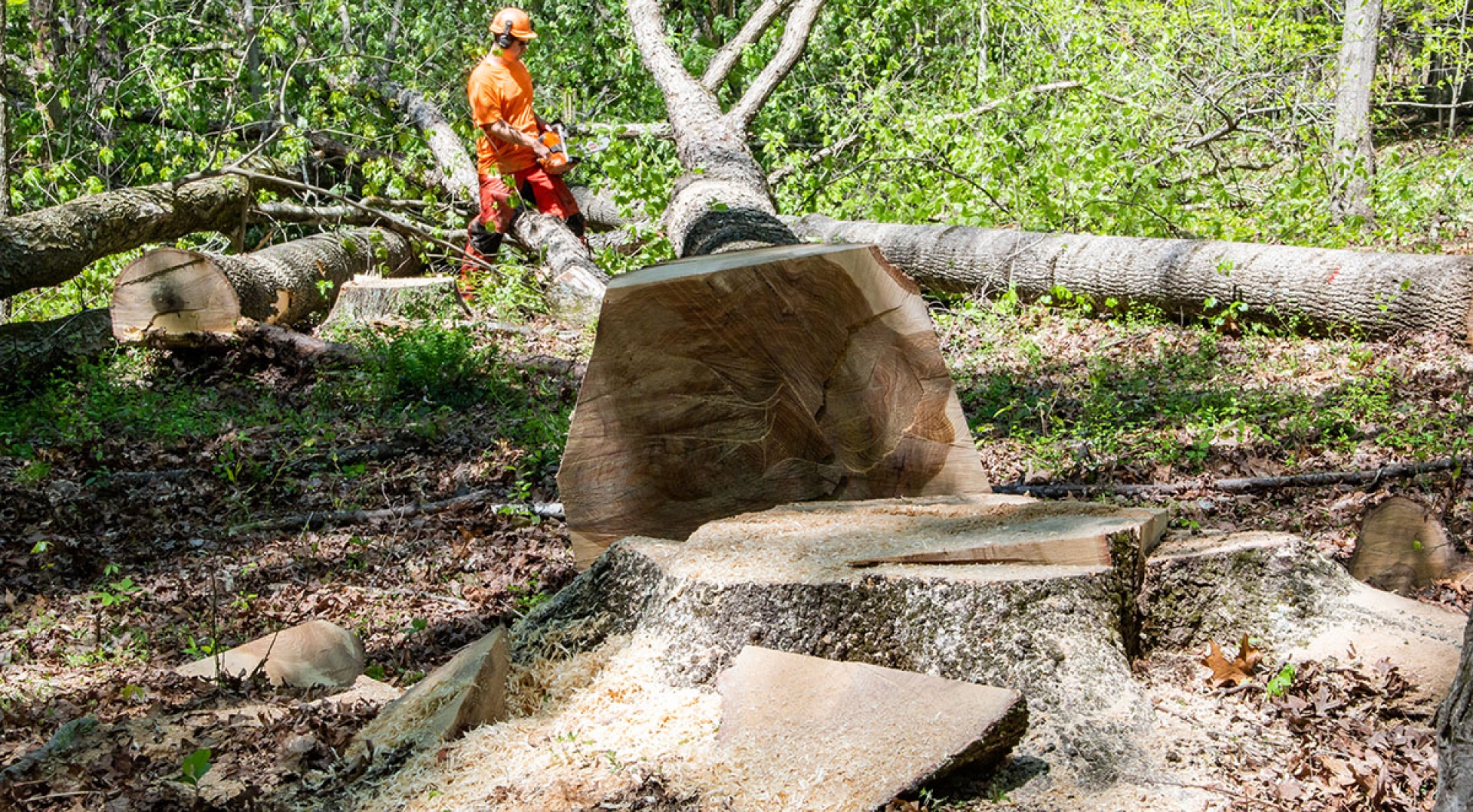
The Advantages of Clear-Cutting
Clear-cutting offers a range of advantages for timber production, forest management, and even ecosystem renewal. It provides efficiency and predictability for mills while ensuring that forests continue to produce high-quality timber year after year.
Key Benefits of Clear-Cutting Include:
- Efficiency and Cost Savings: Clear-cutting allows for streamlined harvesting, transportation, and processing. By harvesting an entire stand at once, equipment can be used more efficiently, reducing both time and fuel use.
- Improved Regeneration: Many Appalachian hardwoods rely on open sunlight to sprout and grow. After a clear-cut, natural regeneration occurs quickly, with thousands of new shoots appearing within the first growing season.
- Consistent Lumber Supply: A scheduled rotation of clear-cut areas ensures a steady flow of material for sawmills and manufacturers. This consistency keeps pricing stable and production timelines reliable.
- Stronger, Higher-Quality Wood: Younger trees grow faster and develop stronger fibers when given room to expand. This leads to straighter grain patterns and denser lumber.
- Wildlife Habitat Renewal: Early-successional forests that emerge after clear-cutting attract a variety of wildlife species, from songbirds to deer, that thrive in new-growth environments.
Clear-cutting supports a continuous cycle of regrowth that keeps forests dynamic and productive. When carried out responsibly, it sustains both industry and nature.
The Drawbacks of Clear-Cutting and How They Are Mitigated
While clear-cutting is highly efficient, it does present challenges that must be addressed through careful planning. The most common concerns involve short-term soil disturbance, water runoff, and temporary loss of canopy. These issues are well understood and can be managed effectively.
Potential Drawbacks of Clear-Cutting:
- Temporary visual changes to the landscape.
- Increased potential for soil movement on steep terrain.
- Loss of shade-dependent plant species in harvested areas.
How the Cons of Clear-Cutting Can Be Mitigated:
- Harvesting is scheduled during favorable weather conditions to minimize ground impact.
- Buffer zones are left around creeks and streams to protect water quality.
- Erosion control measures are installed immediately after harvesting.
- Native hardwood seedlings are allowed to regenerate naturally or are replanted where needed.
With these practices in place, regeneration begins within the first year. Within five years, the area shows strong young growth, and after ten to fifteen years, the site supports a thriving new forest.
How Clear-Cutting Supports the Appalachian Hardwoods Industry
The hardwood industry across the Appalachian region relies on the dependable yields that clear-cutting provides. Without it, sawmills and manufacturers would face irregular supply and unpredictable lumber quality. By harvesting mature stands and allowing new ones to grow, the system creates a rhythm that supports employment, trade, and economic stability.
A reliable timber supply supports furniture makers in North Carolina, flooring producers in Tennessee, and builders throughout the Southeast. Clear-cutting ensures that Appalachian hardwood remains one of the most valued resources in American craftsmanship.
Why Clear-Cutting Makes Sense for Appalachian Hardwoods
The Appalachian landscape is perfectly suited for clear-cutting. Its soils, rainfall patterns, and hardwood composition allow natural regrowth without heavy intervention. Trees such as oak and poplar regenerate from seeds and root systems that respond quickly once sunlight returns to the forest floor. In this way, clear-cutting mimics the natural disturbances that shaped these forests for centuries, such as storms or wildfires.
Because regeneration begins so rapidly, the land never lies bare for long. Saplings soon compete for sunlight and space, developing strong trunks and deep root systems that create durable, high-quality lumber. These natural cycles sustain the forests that provide the raw material for Select Hardwoods’ premium Appalachian products.
Regeneration and the Growth of Healthy Forests in Appalachia
The process of regrowth following clear-cutting is one of the most compelling aspects of hardwood forestry. The transformation begins almost immediately after a harvest. Sunlight reaches the forest floor, triggering dormant seeds and root systems to awaken. Within weeks, sprouts emerge from the soil, and the renewal of the forest is underway.
Over the next few years, the site will change dramatically. By the second growing season, the ground is covered with vigorous hardwood seedlings competing for light and nutrients. Oaks, maples, and poplars quickly dominate, forming dense stands that naturally control weeds and underbrush. Wildlife returns as shrubs and young trees provide food and cover. What once appeared to be a cleared tract becomes a flourishing new stage of forest growth.
Typical Forest Regrowth Timeline:
- Year 1: Seeds germinate and sprouts emerge from stumps and roots.
- Year 3: The area supports thick young growth reaching several feet high, shading out weeds and stabilizing soil.
- Year 10: A young forest canopy begins forming, with trees establishing dominant height.
- Year 20: Maturing hardwoods form a closed canopy and develop valuable lumber qualities.
- Year 30 and beyond: The stand reaches harvest-ready age, completing a full cycle of forest renewal.
Each phase supports a different layer of ecological and industrial value. Early years provide browse and shelter for deer and small mammals, while mid-growth stages strengthen root systems and enrich soil. By the time the trees mature, they represent a new generation of premium Appalachian hardwood ready for the mill.
This cycle of harvest and regrowth is what keeps the Appalachian hardwood industry moving forward. Clear-cutting allows foresters to time these rotations with precision, ensuring there is always a new stand in development. It is not a stop-and-start process but a continuous loop of productivity that benefits both the forest and the regional economy.
For Select Hardwoods, understanding these growth patterns is vital. The regeneration process determines future lumber quality, yield, and consistency. A healthy regrowth cycle means decades of reliable supply and wood that performs beautifully in flooring, furniture, and millwork. Clear-cutting makes this long-term renewal possible, turning forest management into an ongoing process of growth, harvest, and regeneration.
Choose Select Hardwoods for Appalachian Lumber
At Select Hardwoods, clear-cutting plays a central role in how we resource timber for our mills. The approach ensures consistent quality, efficient production, and long-term reliability for our customers. By focusing on strong forest renewal and predictable yield, we help sustain both the industry and the forests that make it possible.
For builders, manufacturers, and craftsmen who depend on premium Appalachian hardwoods, Select Hardwoods provides the materials and consistency needed to bring projects to life. Reach out to us for more information about Appalachian hardwoods.